 ElectrospinTech
Nanofiber membrane fragments with binder
 Using nanofiber membrane fragments and binding agent to form nanofibrous block. |
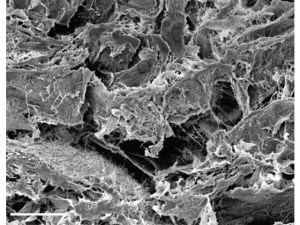 3D scaffold made out of pieces of non-woven membrane [Teo et al STAM 2011, 013002] |
In cases where a relatively larger nanofiber thickness is preferred, crushing of the membrane to form a clump of nanofibrous scaffold is not feasible as the nanofiber membrane will tend to unravel. A simple method to overcome this problem is to cut the nanofiber membrane into pieces. A suitable binder such as gelatin or fibrin glue may then be used to consolidate the nanofibrous pieces.
Advantages
- Standard setup
- Allow culturing of cell on membrane prior to forming 3D scaffold
- Easy translation of 2D culture to 3D
- Allow different materials and cell culture to be mixed together at a later stage
Disadvantages
- Require the use of binders
- Nanofiber pieces may dislodge from the block when the binder de-generates.
A suitable binding material may be blended with the core matrix material for electrospinning. The resultant electrospun membrane may then be chopped into smaller pieces for remodeling into 3D form. Using this method, Meng et al (2024) used polycaprolactone (PCL) as a binding material due to its partial solubility in acetone. A solution of poly(L-lactic acid)/polycaprolactone (PLLA/PCL) was prepared for electrospinning into nanofibrous membranes. The membrane was subsequently chopped into smaller pieces and dispersed in a homogenizer to separate the fiber fragments. Paraffin microspheres as spacing material were dispersed in acetone containing the fiber fragments. A combined suspension of PLLA/PCL chopped fibers, 58S bioactive glass (BG) particles and paraffin microspheres in acetone was loaded into a mold and compressed to push out excess acetone before drying. The dried scaffold with the paraffin microspheres was then washed with hexane to remove the microspheres.
Last updated: 29 April 2025

