Several characteristics of electrospun fibers enable them to be used for cancer detection. Its high surface area and ease of incorporating biomolecules made it highly sensitive as sensor. Capturing or detection of circulating tumour cells has always been a challenge due to its low numbers in the blood stream. Electrospun membranes have been known to facilitate rapid cell adhesion and biomolecules have been successfully incorporated into the fibers for selective cell capturing. This makes it an attractive candidate for detection of tumour cells.
One concept for cancer detection is to use cancer markers. Wang et al (2013) used electrospun polystyrene (PS) fibers incorporated with antibodies to detect three cancer markers, alpha fetoprotein (AFP), carcinoembryonic antigen (CEA) and vascular endothelial growth factors (VEGF). The electrospun substrate was shown to be more efficient and sensitive in detecting the markers compared to conventional planar PS substrates. The improved performance can be attributed to the much higher surface area of the nanofibers that made up the electrospun substrate.
Yildizbakan et al (2024) constructed a electrochemical Immuno-cytosensor by electrospinning polyacrylonitrile (PAN) nanofibers loaded with La0.25Fe0.75FeO3 (PNp)perovskite nanoparticles on a pencil graphite electrode (PGE) surface. The modified electrode was immersed in anti-carcinoembryonic antigen (anti-CEA) solution for adhesion on the surface of the electrode (PGE/PAN@PNp/Anti-CEA). CEA antigen and bovine serum albumin (BSA) were sequentially added to the electrode to complete the cytosensor (PGE/PAN@PNp/AntiCEA/BSA/CEA). Detection of cells is through the electrochemical interaction of the cells with the electrode. The cytosensor have the potential to be used for differentiating CEA-negative from CEA-negative cancer cells. With CEA-negative cell lines such as RT-4(bladder cancer), MDA-MB-231 (triple-negative breast adenocarcinoma cell line), and T98G cells (glioblastoma multiforme cell line), the number of cells attached are low. However, for CEA-positive cells such as MCF-7 cells (estrogen-sensitive human breast cancer cell line, the number of cells attached are greater.
Electrospun fibers incorporated with biomolecules are not restricted to detection of cancer markers. They may also be used in the capturing of circulating tumour cells. The ability to capture circulating tumour cells allows the detection and diagnosis of metastatic cancer cells. Fan et al (2016) used folic acid modified electrospun poly(vinyl alcohol)/polyethyleneimine nanofibers for capturing of cancer cells overexpressing FA receptors such as ovarian cancer and other gynecological cancers. The FA modified nanofibers showed good hemocompatibility and specificity towards the targeted cancer cells. Ueki et al (2016) used electrospun polystyrene (PS) fibers immobilized with anti-EpCAM antibody for capturing of MCF-7 cells that express EpCAM on their surfaces. Constructed with electrospun PS microfibers with membrane pore size of 10 µm, which is about the size of leucocytes and circulating tumour cells, Ueki et al (2016) used the microfiber filter with vacuum aspiration to pass blood through it. The membrane was found to be highly specific in filtering MCF-7 cells from whole blood and a mixture containing CCRF-CEM cells that do not express EpCAM.
For biosensors, the ability to measure dissolved oxygen in the body may help to monitor tumor aggressiveness and resistance to treatment as O2 depletion has been found in the microenvironment of developing tumors. Grasso et al (2025) used poly(1-trimethylsilyl)propyne (PTMSP) as the polymer carrier for oxygen indicator dye ruthenium complex tris(4,7-diphenyl-1,10-phenantroline)ruthenium(II) dichloride (Ru(dpp)32+) and reference dye, rhodamine B (RBITC). PTMSP is ideal due to its high permeability to O2. The indicator dye
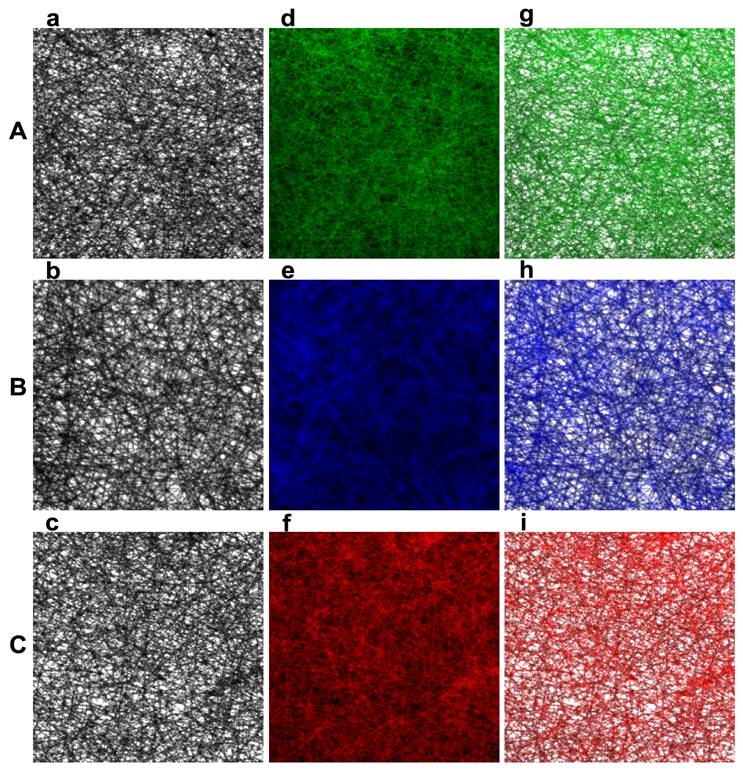
Ru(dpp)32+ works by quenching in the presence of increasing O2 concentrations while RBITC fluorescence emissions are unaffected. Electrospinning of PTMSP loaded with Ru(dpp)32+ and RBITC was electrospun onto a rotating collector to give aligned fibers. Both dyes were found to be evenly distributed in the fibers. Measurement of the fluorophores emission peaks from the dyes in the electrospun fibers was by a microplate reader. The sensing capability of the electrospun fibers were demonstrated using in vitro melanoma co-culture models with the tumour microenvironment modified to be either normoxic or hypoxic. As the sensor is to be used in an aqueous environment for measuring dissolved O2 level, additional tests showed no leaching of the dye was detected over a 7 days period. Robustness of the dye fluorescent was shown by the absence of fluorescence intensity decay from Ru(dpp)32+ and RBITC under longer duration and more intense illumination.
Published date: 24 January 2017
Last updated: 4 November 2025
▼ Reference
-
Fan Z Y, Zhao Y L, Zhu X Y, Luo Y, Shen M W, Shi X Y. Folic acid modified electrospun poly(vinyl alcohol)/polyethyleneimine nanofibers for cancer cell capture applications. Chinese Journal of Polymer Science 2016; 34: 755.
-
Grasso G, Forciniti S, Onesto V, Pierantoni L, Caballero D, D'Amone E, Gigli G, Reis R L, Oliveira M, Mercato L L. Engineered ratiometric Sensory electrospun fibers for oxygen mapping in complex cultures and tumor microenvironment. Biosensors and Bioelectronics 2025; 283: 117481.
https://www.sciencedirect.com/science/article/pii/S0956566325003550 Open Access.
-
Ueki T, Yoshihara A, Teramura Y, Takai M. Fast and selective cell isolation from blood sample by microfiber fabric system with vacuum aspiration. Science and Technology of Advanced Materials 2016. Article in press
-
Wang J, Kang QS, Lv XG, Song J, Zhan N, Dong WG, Huang WH. Simple Patterned Nanofiber Scaffolds and Its Enhanced Performance in Immunoassay. PLoS ONE 2013; 8(12): e82888.
Open Access
-
Yildizbakan Z, Altuntas D B, Nalkiran H S, Aslan S, Mamuk A E, Koçak C, Kurt S, Nalkiran I, Yener C, Ünlü C G. An Electrochemical Immuno-cytosensor Modified with Nanofibers for the Determination of a Carcinoembryonic Antigen. BioChip J 2024; 18: 464.
https://link.springer.com/article/10.1007/s13206-024-00159-x Open Access
▲ Close list
 ElectrospinTech